Your selection
Research / 29.01.2021
Naked mole-rats speak in dialect
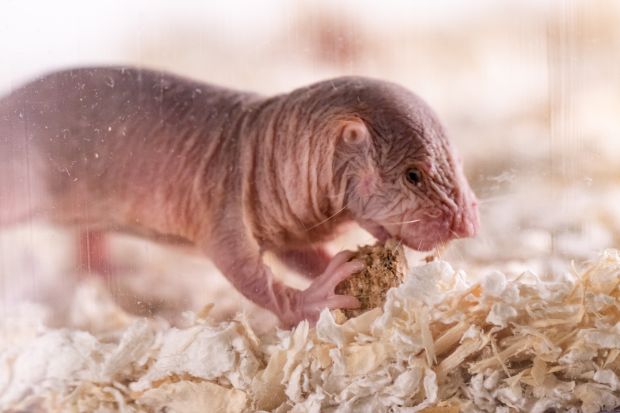
Some converse in Creole, while others speak Scots, but it’s not only humans who can be identified by the diversity of language they speak. Naked mole-rats have their own dialects, too. Shared dialect also strengthens cohesion within a colony, a team led by MDC researcher Gary Lewin reports in the current "Science" cover story.
In the wild, naked mole-rats live exclusively in underground burrows and tunnels in semi-arid regions of Eastern Africa. The rodents obtain all the water they need through their food such as the underground tubers of plants. Credit: Felix Petermann, MDC
Some converse in Creole, while others speak Scots, but it’s not only humans who can be identified by the diversity of language they speak. Naked mole-rats have their own dialects, too. Shared dialect also strengthens cohesion within a colony, a team led by MDC researcher Gary Lewin reports in the current "Science" cover story.
The computer program, which uses AI, didn’t only identify the animals on the basis of their individual voices: “It also detected similarities in the types of sounds made within a single colony,” says Lewin. The program was therefore also able to identify which colony a specific individual came from. “That meant that each colony probably had its own distinct dialect,” says Barker. But at that point, the research team did not yet know whether the animals were aware of that, and whether they could recognize their own dialect and distinguish it from others.
A preference for kith and kin
In order to find out both those things, Barker performed several experiments. In the first, she repeatedly placed one naked mole-rat in two chambers, connected via a tube. In one chamber the chirping of another naked mole-rat could be heard, while the other chamber was silent. “We observed that the animals always immediately headed for the chamber where the chirps could be heard,” says Barker. If the sounds were made by an individual from the test subject’s own colony, it would give an immediate vocal response, but if they were made by an individual from a foreign colony, the mole-rat would remain silent. “That enabled us to infer that naked mole-rats can recognize their own dialect and will selectively respond to that.”
To ensure that the test subjects were responding to the dialect and not to the voice of an individual known to them, the researchers deliberately created artificial sounds. These contained characteristics of each dialect but did not resemble the voice of a specific individual. “The naked mole-rats produced vocal response to the chirps developed by the computer,” reports Barker. And the experiment worked even when the chamber where the familiar and trusted dialect could be heard was given the scent of a foreign colony. “That demonstrated that the naked mole-rats were responding specifically to dialect rather than scent, and that they have a positive reaction to hearing their own dialect,” says Lewin.
Foster pups learn the dialect of their new colony
In further experiments, the researchers placed three orphaned naked mole-rat pups in foreign colonies where the queen – the only female in naked mole-rat colonies that reproduces – had also recently had a litter. “That ensured that the new arrivals would not be attacked,” explains Barker. “Six months later, our computer program showed that the foster pups had acquired the dialect of their new home.”
It was rather more by chance that the team discovered another interesting fact: a naked mole-rat queen isn’t only responsible for reproduction in her colony, she also plays a decisive role in controlling and preserving dialect integrity. “During the course of the study, one of our colonies lost two queens within relatively quick succession,” says Lewin. “In the anarchy that ensued, we observed that the vocalizations of the other naked mole-rats in the colony began to vary much more widely than usual. Dialect cohesiveness was thus greatly reduced and didn’t return until a few months later, with the ascendance of another high-ranking female as the new queen.”
Insight into the basic workings of human culture
“Human beings and naked mole-rats seem to have much more in common that anyone might have previously thought,” concludes Lewin. “Naked mole-rats have a linguistic culture that developed long before human beings even existed. The next step is to find out what mechanisms in the animals’ brains support this culture, because that could give us important insight into how human culture evolved.”
Text: Anke Brodmerkel
Downloads
Audio examples. Credit: Alison Barker, Lewin Lab, MDC
https://www.mdc-berlin.de/news/press/naked-mole-rats-speak-dialect
Overview News
News Buch Berlin
“The coolest part is vortexing”
One week, two topics, and plenty of new experiences: 25 young people take a deep dive into research on rare diseases and immunology at the Life Science Learning Lab “Gläsernes Labor,” including by ana...
more ...Kirstin Bodensiek appointed Administrative Director
As of August 15, 2026, Kirstin Bodensiek has officially taken the helm as Administrative Director of the Max Delbrück Center. She is stepping into the permanent position after leading the center on an...
more ...Eckert & Ziegler Remains on Track in the First Half of 2026
Eckert & Ziegler SE (ISIN DE0005659700, TecDAX) reported sales of €149.3 million in the first half of 2026. The group’s adjusted EBIT dropped by just under 6% to €33.3 million. Adjusted EBIT in the Me...
more ...Events Buch Berlin
25.08.2026, 18:00
Campus-Kino: "In Zeiten des abnehmenden Lichts"
Anders als im Jahresprogramm angekündigt, wird die Verfilmung des gleichnamigen Romans von Eugen Ruge "In Zeiten des abnehmenden Lichts" gezeigt. Regie führte Matti Geschonneck und der Kinostart war a...
more ...25.08.2026, 18:30
Podiumsdiskussion mit Politiker:innen zum Schwerpunkt Wohnungsbauvorhaben in Buch, speziell "Buch am Sandhaus"
Unter anderem geht es um den Schutz der angrenzenden Naturräume, die Moorwiese, den Ausbau des ÖPNV und Anpassungen des B-Plans 3 - 95
more ...01.09.2026, 08:00
Aktualisierungskurs für Projektleiter und Beauftragte für Biologische Sicherheit nach § 28 GenTSV
Ein-Tages-Onlinekurs mit gesetzlich vorgeschriebenen Lehrinhalten, anerkannt und zertifiziert vom Landesamt für Gesundheit und Soziales (LAGeSo)
more ...