Your selection
Research, Patient care, Education / 14.08.2025
Promoting awareness of health research
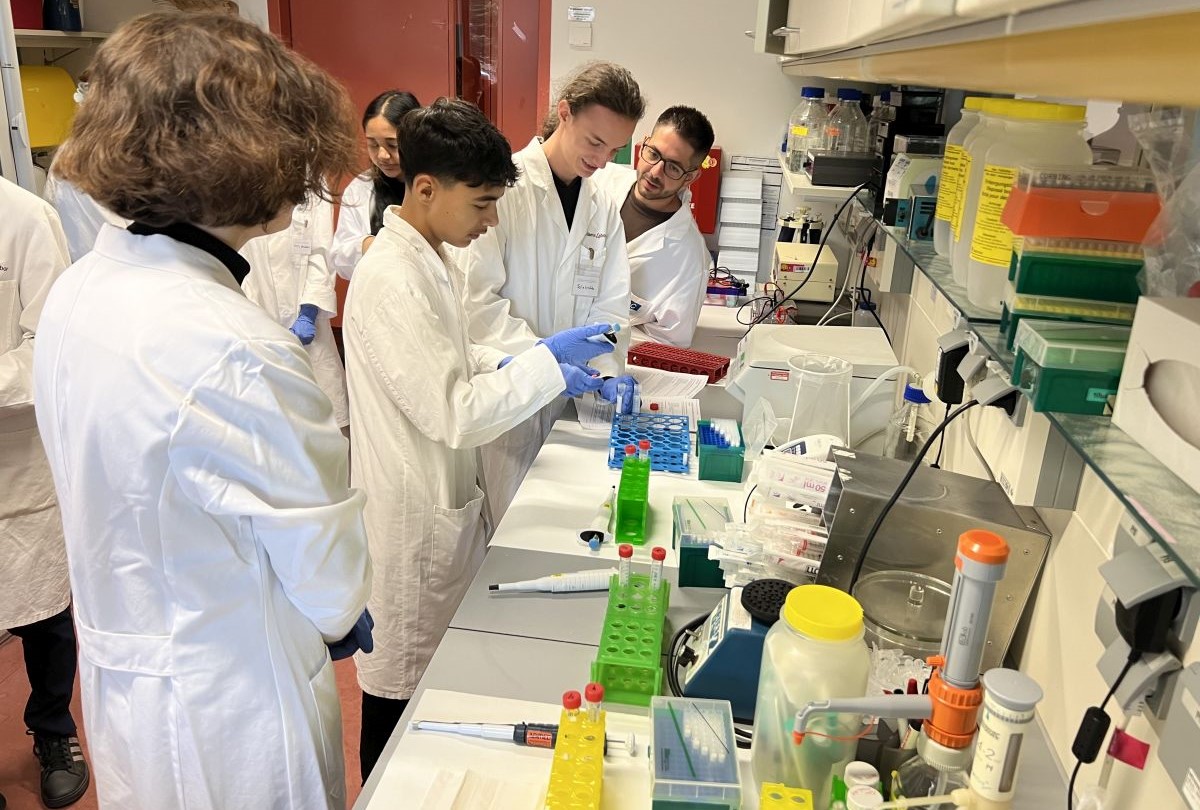
During a week-long course at the Gläsernes Labor, 24 teenagers delved into genetics, immunology, and allergic disease. The course marked the beginning of a new collaboration with the Max Delbrück Center, Charité – Universitätsmedizin Berlin, the German Center for Child and Adolescent Health and others.
Dr. Aleix Arnau Soler, you’re a scientist in the Molecular Genetics of Allergic Diseases lab at the Max Delbrück Center and helped launch this project week in July 2025. How did it come about?
Dr. Aleix Arnau Soler: I took part in a science communication workshop organized by our communications department in 2024. The goal was to develop initiatives for our Life Science Learning Lab “Gläsernes Labor” that integrate new developments in research. I’m also affiliated with the German Center for Child and Adolescent Health (DZKJ), a government-funded network established in 2024 to strengthen research in pediatric and adolescent medicine. The DZKJ is working on strategies to actively involve children and families in health research.
What does that look like in practice?
For example, engaging with children directly, sparking their interest in research, and showing them how we investigate the causes of diseases. Because this work focuses on child health, the DZKJ wants to start conversations with kids and their parents early on. They were looking for partners to help put these ideas into action...
...and you were already involved with the Life Science Learning Lab on the Berlin-Buch campus.
Exactly. The Gläsernes Labor – with its experienced education team, established teaching formats, and strong ties to the campus research community – was an ideal partner. So the DZKJ teamed up with the Max Delbrück Center, Charité - Universitätsmedizin Berlin (Pediatric Clinic), the German Rheumatology Research Center (DRFZ) and the Gläsernes Labor, to design a course on genetics and immunology, including immune response and allergy treatment. These are issues that affect many people, including children and teens. The participants had the chance to explore the science in these areas in a real research setting – and hopefully came away with a deeper appreciation for the importance of health and health research.
How did you select participants for the project week?
The students came from the Robert Havemann Gymnasium in Berlin, which has an ongoing partnership with the Gläsernes Labor. One group focused on genetics, the other on immunology. They carried out hands-on experiments like DNA isolation, PCR, and electrophoresis. At the end of the week, they created posters to present their findings at school. Our lab hosted the immunology group. We showed them a diagnostic test for allergies, for example, and walked them through a key step in the DNA isolation protocol: adding alcohol to a blood sample, which causes the DNA to form a visible “cloud.” The students were highly engaged and clearly enjoyed the experience. I completely understand – back when I was in school, it would have been unthinkable to get that kind of inside look at how research is done at a scientific institute.
Will the collaboration continue?
The DZKJ is currently undergoing evaluation for its next funding period. Once that process is complete, I expect the partnership will be extended for several more years, allowing us to develop new program formats. One idea for the future: patients with conditions such as obesity, cystic fibrosis, or hearing loss who are being treated at Charité could be offered tailored courses that provide research-based insights into their conditions – why they occur and how to manage them. I think that would be a powerful way to bring science closer to people and, at the same time, give us an opportunity to learn more about what people need or expect from research.
Interview: Wiebke Peters
Further information
- 25 years of the Life Science Learning lab
- Gläsernes Labor
- Education for students and teachers
- German Center for Child and Adolescent Health
Photo: Dr. Aleix Arnau Soler and PhD student Alisa Iakupova gave students from the Robert Havemann High School an insight into allergy research in the laboratory. © Prof. Dr. Young-Ae Lee, Max Delbrück Center
Source: Max Delbrück Center
Promoting awareness of health research
Overview News
News Buch Berlin
“The coolest part is vortexing”
One week, two topics, and plenty of new experiences: 25 young people take a deep dive into research on rare diseases and immunology at the Life Science Learning Lab “Gläsernes Labor,” including by ana...
more ...Kirstin Bodensiek appointed Administrative Director
As of August 15, 2026, Kirstin Bodensiek has officially taken the helm as Administrative Director of the Max Delbrück Center. She is stepping into the permanent position after leading the center on an...
more ...Eckert & Ziegler Remains on Track in the First Half of 2026
Eckert & Ziegler SE (ISIN DE0005659700, TecDAX) reported sales of €149.3 million in the first half of 2026. The group’s adjusted EBIT dropped by just under 6% to €33.3 million. Adjusted EBIT in the Me...
more ...Events Buch Berlin
23.09.2026, 17:00
Einladung zu Konzert und Vortrag: „Musik trifft Wissenschaft“
Mit den Pianisten Ruihan Jiang und Leo Wang Ziqiao und der Wissenschaftlerin Dr. Daria Bunina, die die Frage "Wie bildet dieselbe DNA sowohl das Gehirn als auch das Herz?" beleuchtet.
more ...26.09.2026, 15:00
Pankepark-Fest mit Eröffnung des neuen Teilabschnitts zwischen Panke und S-Bahnstrecke
Großes Mitmachfest mit Aktionen, Spaß und Sport
more ...09.10.2026, 08:30
Lehrkräftekongress 2026: "Kompetenzförderung im MINT-Bereich durch vernetztes Denken!"
Lehrkräftekongress des Schülerlabor-Netzwerks GenaU
more ...